The Pleiades is a cluster, not a single sun
The Pleiades contains a real population of young.
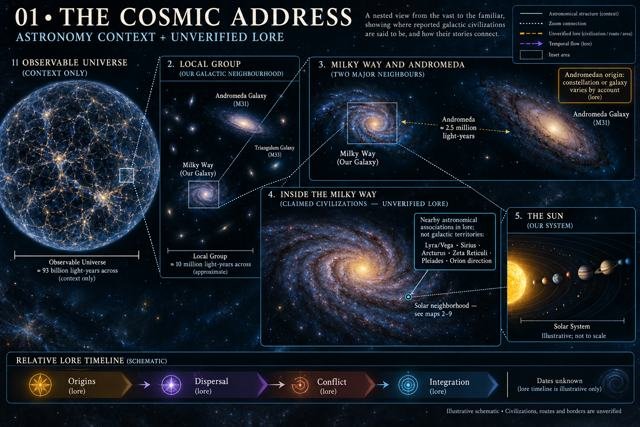 Illustration, not a photograph or scientific reconstruction.
The Pleiades contains a real population of young stars.
A useful map labels the cluster and separates its astronomical distance from any alleged home world.
This distinction matters when reading an illustrated knowledge base. A polished image can make different kinds of information feel equally certain. The reader benefits from separate labels for an astronomical measurement, a reported experience, an author’s interpretation and an artist’s invention.
When comparing sources, record the question each source can actually answer. An observatory may constrain the distance to a star; a transcript may document the wording of a belief; a design notebook may explain why a ship has a ring. None of those documents automatically answers all three questions.
A practical way to read this article is to revisit one map or dossier and identify a statement that belongs to each layer. If a necessary source is missing, keep the point provisional. If sources disagree, note the disagreement rather than inventing a hidden explanation to unite them.
Reading path: https://science.nasa.gov/solar-system/skywatching/night-sky-network/spot-the-young-stars-of-the-hyades-and-pleiades/ . This launch feature is an editorial explainer, not a report of a new discovery.